Tuesday, 12 April 2016

Evaluation 1- Natalia

In what ways does your media product use, develop or challenge forms and conventions of real products? 


Our final product of an opening to a thriller film conformed to the conventions and forms or real media products in many ways, this 9 frame title sequence of our media product gives a brief idea of what my group and I cooperated into the opening in order for it to conform to the conventions of a real life media product, examples of this are our production and distribution companies 'Breeze-block Productions' and 'Clockwork Distributors'. 


Production Logos:


My group and I created the production and distribution company logos presented on the right-hand side. Before we went onto creating them we were obliged to research other company names and logos, on the left-hand side you can see examples of real media products

What we noticed about how production companies are cooperated in real media products is that they are animated, like for example Dream Works. After attempting to create something similar, we decided that our production company will not involve any movement as it does with Dream Works whereby there is a close up to the character on the moon, instead we used the sound effect of a typewriter in the background to create a sort of mysterious beginning, this way the audience will be intrigued to know what this sound is and why can they hear it. 

However a common trend which we noticed was that the name of the company usually matches the image it presents, for example Universal uses the universe, therefore we decided to create the 'Clockwork Distributors' using the image of a clock to conform to a real product. I thought this was a very realistic logo for a distribution company, as well as this the sound effect of the typewriter, which to some viewers could be interpreted as the sound of a clock ticking or an old camera filming, which also creates a mysterious atmosphere. 


Title:


Our title 'DiSoRiEnTaTiOn' was decided as a group also to highlight the idea that our protagonist is confused, she is completely unaware of the antagonists presence in her house. She becomes frightened when she knows that somebody is in the house. The use of mixture of smaller and larger letters just adds to the feeling of being disorientated and confused as the protagonist is, this is to immerse the audience into our opening so that they understand how the protagonist must be feeling, as the characters are also young, our targeted audience which is the younger demographic will find it easier to relate to the film. 

Our title of the film as well as the entire idea of the opening to the thriller has come from sections of the film 'Sinister' (2012).


Our title of the film comes at the beginning as my group and I decided to prevent it from looking like a trailer. I thought it was really effective in the way that the writing fades onto the screen in Sinister and we recreated this in our own opening as it, in our opinions, was a very successful way to begin a thriller. In terms of atmosphere, to the audience this title would in fact look very sinister, the actual name and the way it has been written on top of the clip in the background also adds to this sinister atmosphere which I thought was very effective. Our title came before any of the directors or the crew were credited so that the audience would instantly be aware of the name and they perhaps make assumptions of what our film could be about.


The Antagonist:


With the antagonist on the left-hand side, we decided to keep the characters face covered, like the antagonist of the 1979 film 'Stalker' (Tarkovsky). As a group we decided that it would be most effective if the antagonist face was covered as the audience would be more eager to find out who this person is and why they are in somebodies house, however, we decided to use a female character as opposed to a male character which would stereotypically be used in thrillers similar to our own like for example 'Stalker'. Personally I thought that this would make the opening a lot more interesting as it would open a door to interpretation of the opening by the audience. This would lead to questions such as "why is this girl in another girls house?" or "why is she raiding through her drawers?". The antagonist is also dressed in all black, we noticed that in the film Stalker the antagonist in the picture on the right-hand side is also covered by shadow using lighting, we interpreted this by using costume. Overall this was effective as it made the character more mysterious, although the character may not look dangerous, it raises the questions of "why are they present in this house?".

You can clearly see that both actors are playing the role of young females, so perhaps the audience would be thinking about what happened between the two in the past to make the antagonist act in the way that she did. 


Constant shots of the antagonist from behind and the effect of the hand-help camera makes the audience feel as though this is from their point of view and they are present at the scene, the fact that they are unaware of the appearance of the character they become more immersed in the opening.


The rest of the shots of the antagonist also follow this trend of it being a point of view shot of the audience member, this keeps the mysterious atmosphere, in which the pace increases as the antagonist trashes the room looking for items as the protagonist is getting closer to her home.


The Protagonist:


The protagonist is mainly only seen walking home or performing ordinary actions such as looking through the mail. The characters entire body is visible, her clothes are very bright and she looks very casual. This is the complete opposite to the antagonist who is dressed in all black and therefore this creates the contrast between the two locations: the protagonists house and the road on which she is walking home.
The contrast between the two scenes builds a faster pace as there a jump-cuts between both scenes, this in my opinion keeps the audience interested to find out what's going on. As the protagonist gets closer and closer to the house, the tension really begins to build and the pace increases which can really immerse the audience into our opening. The protagonist and the antagonist are the only two characters to be introduced in our opening in which their names appear within the credits of the opening. The actors names appear after the directors during the scenes which they are seen in so that the audience is aware of who is who. The font which the credits and the title are presented in is the same throughout, we used this as it was the most similar to the film Sinister. This type of font is effective because it makes it clear to the audience what genre this film will be, the way that the credits fade onto the screen is very eerie too which helpful in terms of creating an atmosphere.


Camera-work:


In the shot where the protagonist is reaching her house, we also interpreted the idea from the film Sinister, at this point the pace is very quick as the protagonist is almost in the house and the antagonist knows that she does not have much time to be in the house, hence the reason her movement is very rapid and violent.


The point of view shot from the protagonist again can immerse the audience into the opening as they are metaphorically reaching the house with the protagonist however they are aware that the antagonist is in there and therefore the audience will be eager to know what will happen once the protagonist reaches the house.


Sound:

The idea of the use of the sound effect of a typewriter was also used from Sinister, this sound of a typewriter can be interpreted as film tape, which is how my group and I imagined it. This is an example of one of the non-diegetic sounds which we decided to use in our opening, this is sound which only the audience can hear. Another example of non-diegetic sound which we decided to use begins playing as the title fades onto the screen, this created a lot of tension as soon as the opening began. The music used was produced by a woman playing on a water-phone, this instrument is used in the background of a lot of horror and thrillers.

We also have many diegetic sounds within our opening which are sounds that both the characters in the opening and the audience can hear. These are sounds such as the wind blowing or the birds chirping. These sounds can make the audience feel as though they are a part of the opening, therefore making it a lot more realistic to the viewer.

Sunday, 3 April 2016

Evaluation 6 - Katie

Evaluation Activity 6) 


What have you learnt about technologies from the process of constructing this product?


Evaluation 5 - Katie

Evaluation Activity 5) 


How did you attract/address your audience?


To attract an audience for a film, you must catch the attention of the public. To do this you would use marketing campaigns such as social media (having Twitter/Facebook pages for your film where you would post information about it and where the fans could follow the latest news) as well as posters and official movie websites. 
Below is a mind map of all the ways you could attract an audience to a film and the marketing campaigns that are used. Films with a bigger budgets can make a larger marketing campaign compared to smaller independent films where the budget may only be a few thousand. The  If it is a Hollywood film with a big budget then more famous actors can be casted, as well as well known directors. If this is the case, then the film will probably be marketed and talked about a lot more than if an independent film. 


In regards to our own thriller, I made a poster that I imagine would be put up in cinemas and on the DVD cover. This poster indicates that our film is a thriller due to the black and white background and the mysterious slogan. 

    • Red writing "You never know what's going on behind closed doors" = slogan for film - makes an audience question what does happen behind closed doors and what happens in this film
    • Red = colour of blood
    • Red writing stands out against black and white of the whole poster 
    • Poster image = person in house
    • Title of film 'Disorientation'  in big letters to stand out - writing is slightly different to the usual so therefore might intrigue people
    • Date of release on poster - in a larger font to stand out to audience
    • Rating on poster (15) - allows audience to know if they can see it or not. Also lets audience know what to expect (what you get with a 15 rating)
    • Slightly blurry picture in the background connects to the title - image is disorientated
    • Black and white poster creates mystery, intriguing audience.


    The poster I created is similar to other thriller movie posters, such as 'Orphan', 'The Call' and 'The Roommate'. The poster for 'Orphan' is just a close up of the main character. This creates mystery which I made in our poster by the black and white background and by just using the bottom half of someone

    All of these movies have slogans that relate to that movie alone, and when someone hears that slogan they think of the movie. I have created my own slogan that I think holds mystery and intrigues an audience. 

    I think that posters are an effective way of promoting a film because it captures the attention of the audience immediately. A poster can intrigue an audience member which may result in them researching the film further. As well as this, they can share the poster on various sites or by word of mouth.


    Furthermore, through the internet you can attract an audience. Social media websites like Twitter and Facebook help to promote the film. Twitter is a platform where people can write their reviews on the trailers/movie. It's also a place where people can hear about the film. This is the same with Facebook and Tumblr. Youtube is slightly different, because this is where everything is posted. For example, this is where trailers are posted, reviews from all different types of people are posted and also a place where you can learn about the film, like on channels that talk about the red carpet events and latest movie news.
    Below I have made my own Twitter page for our film.


    Conventions Of A Thriller include:

    • Tension and Suspense
    • An antagonist and protagonist
    • Plot twists which keep audience guessing and on the edge of their seat
    • Red herrings which mislead the audience with information
    • Cliffhangers
    • Trick endings
    • Clues pointing to the ending
    It is difficult to incorporate all of these conventions in our thriller because it is just the opening and not the whole film. However ours does include tension and suspense, an antagonist and protagonist and (could be argued)red herrings.

    Below is an evaluation of our thriller opening. I discussed what happens in our media product and how this creates suspense and tension. Our thriller involves a lot of unanswered questions which would keep an audience intrigued and wanting to watch the film to find the answers to these questions. 


    Saturday, 2 April 2016

    Evaluation 4 - Katie

    Evaluation Activity 4)


    Who would be the audience for your media product?


    In this powerpoint I described who I think the audience for our thriller movie would be and why. I also explained people who probably wouldn't be interested in seeing our movie (younger children and older people). Also, I described the age rating for our film and why I would pick that, as well as identifying 3 main target audience groups (young males, young females and young adults) ranging from the ages of 15-20+. 


    Shot A (left)


    Shot B (below) 


    Friday, 1 April 2016

    Evaluation 3 - Katie

    Evaluation Activity 3)


    What kind of media institution might distribute your media product and why?

    In our opening, it was essential that we included a production company and logo, along with a distribution company and logo. Making these things were crucial to a film opening, as a production process and distribution is what every film has to go through. Below you can see our own original companies logos. 


    Production is a crucial aspect when making a film. There are 3 distinct stages of film production, including: Pre Production, Production and Post Production.

    Pre Production includes

    - Cast and crew
    - Location
    - Script
    - Studio/Set
    - Lighting
    - Director 
    - Producer 
    - Budget


    Production includes

    Actually picking up the camera and filming the movie in the studio or on the set. A big crew is needed for this part of the process, as lighting crew, camera crew and directors/assistances are all needed. The end result of the production process is what an audience will be paying to view, therefore is a key stage in making a film. Independent films, such as 'Sixteen' (Brown, 2013) will not take as long to film as Hollywood films. 'Sixteen' actually only took 3 weeks to film compared to Hollywood's big seller 'Jurassic World'(Trevorrow, 2015) which took 10 years to make it to the screens.

    Post Production includes:
    - Editing
    - Trailers 
    - Soundtracks
    - Making posters
    - Special/sound effects


    Distribution is a crucial part of films as it requires an audience to be made. This can be done in a variety of ways. A distributer focuses on two main aspects, logistics (to get the film to the exhibitor) and marketing (to create an audience for the film). 

    The main distributors in the UK are 
    - Warner Brothers 
    - 20th Century Fox
    - Sony Pictures
    - United International Pictures 

    Examples of independent distributors in the UK are
    - BBC Films
    - Film 4
    - Studio Canal
    - Filmbank 

    Below is a mind map I made that shows all the ways in which an audience can be made for a film.


    Our film is vaguely similar to that of 'The Call' and 'The Roommate'. 'The Roommate' was produced by 'Vertigo Entertainment' and was distributed by 'Screen Gems'. I think a companies like these would distribute our film as it is similar to previous ones they've distributed. 

    To create a marketing campaign for our work 

    • Posters
    • PR + Press
    • Cast
    • Public transport 
    • Merchandise 
    • Internet 
    • Cinema 
    • Radio
    • TV/DVD

    The budget of a film can affect the distribution. For example, if a film has a larger budget, more high profile people can be hired (such as the actors left and right). If these actors are hired, the film is more likely to get more publicity. 

    However, these actors are more likely to get hired for a Hollywood blockbuster rather than a UK Independent film, which I believe ours would be. 

    I think our opening would be a UK independent film because a UK independent film is usually made completely outside of the major film studio system, which our opening obviously is as we filmed it at Natalia's house. 
    Furthermore, our film had no budget at all, and UK independent films have very low budgets. For example, Sixteen (Brown, 2013) had a budget of under £60,000. 


    Evaluation 2 - Katie

    Evaluation activity 2)


    How does your media product represent particular social groups?


    Here is a video of me talking about how our film represents gender/age and how we may attract a target audience, as well as the possible rating for our film.

    In our thriller opening we tried to steer away from the norm where the antagonist is a male stalking an innocent female. To do this we made our antagonist female, making our opening already not stereotypical. 
    We also wanted our thriller opening to be original. Even though the concept of our idea is quite unoriginal and stereotypical in the thriller genre, we still managed to make ours stand out slightly and made it our own through the use of black and white flashbacks and the fact we have represented gender in a complete different way to usual. 


    Evaluation 1 - Katie

    Evaluation Activity 1)


    In what ways does your media product use, develop or challenge forms and conventions of real products?


    Here are 9 frames from our thriller opening


    In order for our thriller opening to conform to the conventions and forms or real media products, we created our own distributor and production company logos which many companies use in real life, such as 'Disney' or 'Universal'. On the left are the logos we designed for 'Breezeblocks Productions' and 'Clockwork Distributors' and on the right are examples of company logos that are used in films today.


    At first we wanted the title of our opening to appear at the end, however, we found that by doing that our film opening would have looked more like a trailer, therefore we decided to have our title at the very beginning of our opening.


    The only thing we did slightly differently to other thriller movies is that instead of introducing the characters first and showing the credits (director, script writer, etc) we showed the title straight away to immediately get right into the opening. 
    Our title includes a mixture of capital and lower case letters  ('DiSoRiEnTaTiOn') because we wanted to make it seem like the whole opening is slightly disorientated. 

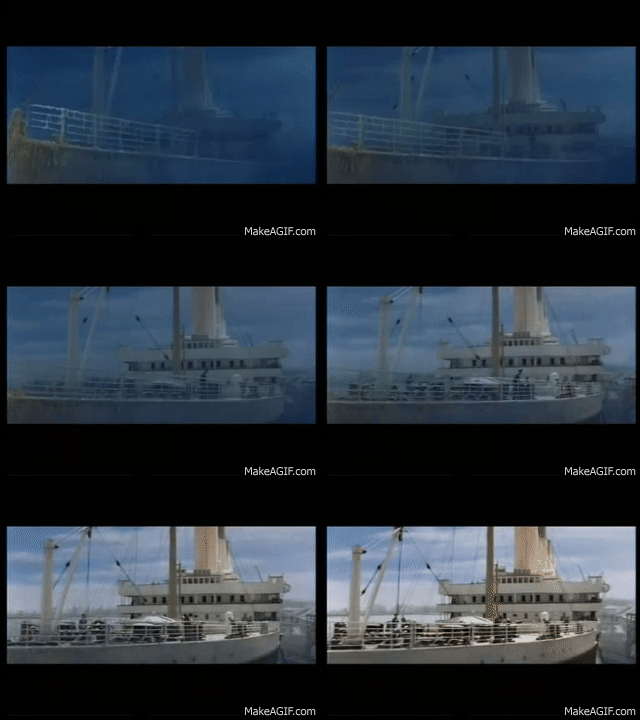
    In order to do this, we used many flashbacks in our opening. The flashbacks are used when our protagonist gets home and follows the same route as our antagonist, for examplewhen the protagonist (portrayed by Natalia) walks up the stairs, it cuts to a black and white flashback because the antagonist (portrayed by myself) previously made their way up the stairs, however Natalia's character is completely unaware of this. We got this idea of flashbacks from films such as 'Saving Private Ryan', 'The Notebook', 'The Conjuring' and 'Titanic' where flashbacks are used in the opening scene. The flashbacks may also make the audience feel tense, as they know something the character doesn't. 


                               B&W flashback in our opening


    Flashback in 'Titanic'


    Furthermore our thriller opening conforms to real film openings through our camera angles and the use of the establishing shot. Our location of our film was the protagonists house and this shot (below to the left) clearly introduces that. This could possibly make the audience watching feel slightly 'creeped out' as this shot may be implying that was is going on inside this particular house could happen in any house, and if this was a real movie and people went to view it in the cinema, it could possibly result in them feeling a slight discomfort in their own home because they may be thinking about what could happen. 

    When filming, we got Natalia to hold the camera. It is slightly shaking to portray the fact she is walking. The point of view shot make the audience feel like they are in the protagonists shoes. This may make them feel slightly uneasy and tense, as previously in the opening we have made it clear there is someone in the house. 

    Our shot of the house can also make the audience feel tense because from the outside it looks completely normal and ordinary whereas inside they are aware there is a villain, and because the protagonist is so blissfully unaware of what is inside, tension is created. 

    The scene we used for our own opening could be compared with a scene from the film 'The Woman in Black' (right) where an establishing shot of the house could result in the audience feeling uncomfortable.


    Other shots from our opening create tension, a key convention of a thriller. For example, shot A and B create tension as they indicates the idea of being watched. It is even more tense and uncomfortable for the audience as the protagonist is being watched from a window in their own house, therefore indicates some sort of intrusion. 

    Shot A                                                


    Shot B

        Also shot C (above on the right) creates tension because it shows the antagonist ripping off a photograph of the protagonist and a friend. They leave the ripped photo of the friend on the floor, taking the bit with the protagonist, which may confuse the audience and leave them to wonder why the antagonist took the photo and what they are going to do with it. This shot also makes it clear that our thriller's sub-genre is a stalker thriller. 
    Finally, the fact the antagonists face is never revealed creates tension, as the audience do not know how if they know the person they're stalking, why they're doing it or for how long. It leaves a lot of questions.  

    The music we used for our thriller opening is similar to the music in the film 'Sinister'. It creates tension and makes the audience feel slightly on edge and tense. We used music to create the feel of disorientation, for example during the flashback clips we used the sound of a film tape/clicker.